

County Magazine | October 28, 2026
The I-69 connection
A decadeslong effort aims to connect more Texas counties to the interstate system
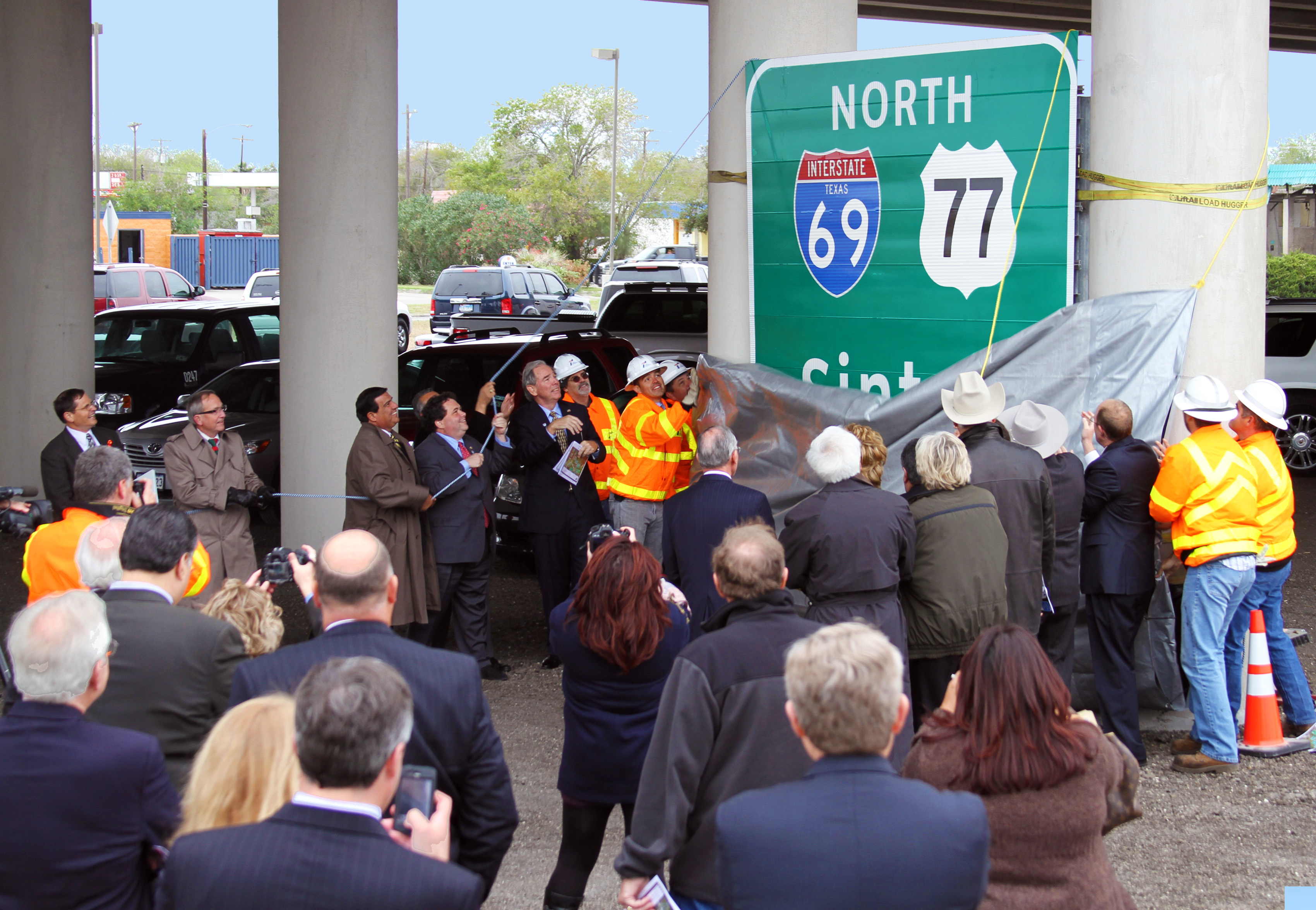
Along the Texas coast, seaports stretch from Brownsville to Beaumont, hugging the Gulf of Mexico and serving as gateways for global trade. Cargo brought in and shipped out at these ports — crude oil, agricultural products, fertilizer, consumer goods — is critical to the state and U.S. economy, with imports moving northward on highways toward Texarkana before continuing beyond Texas to the rest of the country.
Interstate 69, a transportation corridor taking shape through the eastern half of Texas, will soon strengthen that connection. More than 30 years in the making, the interstate is expected to bring new opportunities for economic development while improving roadway safety.
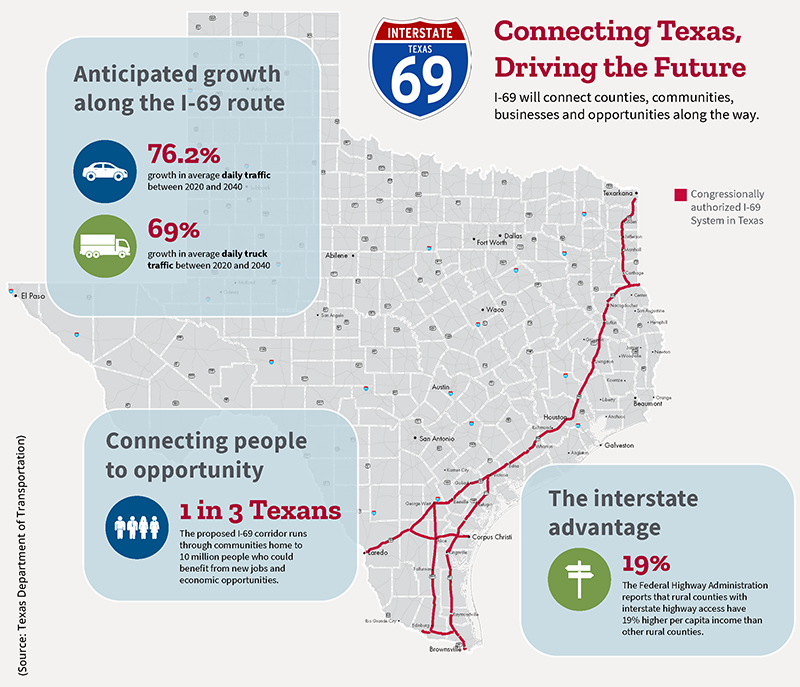
But completing the corridor remains a long-term effort. So far, 228 miles of the I-69 system have been completed and approved, with 800 still to go.
The biggest challenge to finishing it: funding.
“It’s more expensive to build interstate-caliber roadways, which have specific standards,” said Jennifer Shepard, executive director of the Alliance for I-69 Texas, which advocates for its construction. “Every mile Texas builds on I-69 has to compete with other projects for funding.”
The federal interstate system was established in 1956, when President Dwight D. Eisenhower signed legislation providing dedicated funding to build highways connecting goods and people across the country. By the 1990s, with 45,000 miles of interstate constructed, the government declared the system complete.
But the need for interstates has continued. Since 1956, trade has surged by 14,000%, the U.S. population has doubled, and the economy has expanded sixtyfold.
Congress has since identified more than 100 needed priority corridors across the country, but only 12 have been authorized as future interstates, including I-69, which will eventually connect Texas to the Canadian border in Michigan.
“There is a case to be made that I-69 is the most important,” Shepard said. “If you look at the amount of freight crossing the border at Laredo and the Lower Rio Grande Valley, the bulk of U.S.-Mexico trade is coming through that region.”
Despite the importance, there is currently no dedicated funding to finance I-69’s construction, with the state and the Texas Department of Transportation on the hook for much of the cost, as they vie for federal money to support the project.
Where I-69 has been completed, businesses are already moving in, including a Tesla lithium factory in Nueces County and a Union Pacific Mainline Texas Industrial Park in Fort Bend County.
Even more growth is expected along the remaining portions of the interstate as they are completed, meaning jobs and new opportunities for the 10 million people — one-third of the state’s population — who live along the route through Texas.
The Federal Highway Administration reports that rural counties with interstate highway access have 19% higher per capita income than other rural counties.
“The interstate highway system as a whole has been a visual example of a federal program that has paid significant dividends,” Victoria County Judge Ben Zeller said. “In Texas, it has had and will continue to have many positive impacts on our counties.”
Zeller has been involved in the I-69 alliance since he took office in 2015. Early on, he recognized the importance of the interstate to the continued growth and development of the Port of Victoria, strengthening its connectivity to markets across Texas and the U.S. He also saw I-69 as an important public safety investment, providing a safer and more reliable evacuation route for the region in the event of a hurricane.
“I was county judge in 2017 when Hurricane Harvey hit our region,” he said. “I know the necessity of having effective evacuation routes.”
In Victoria County, I-69 consists of upgrades to U.S. 59 to meet interstate standards, including controlled access without traffic signals or private driveways, additional lanes and other safety improvements. Across Texas, I-69 is being developed incrementally through similar upgrades to U.S. 59, U.S. 77, U.S. 281 and State Highway 44.
Currently, 20 of the 34 counties that will include portions of I-69 are not connected to the national interstate system, which Shepard said means for years they have been “left behind.” When businesses are selecting sites for their factories and facilities, they often skip areas that don’t have a connection to an interstate.
“While Texas has grown significantly over the past decades, that growth is not distributed evenly,” Zeller said. “Developing I-69 in Texas really helps ensure that rural Texas counties are able to take part in the state’s economic success rather than getting bypassed by it.”
Much of Texas’ growth has been concentrated along the Interstate 35 corridor, bringing economic benefits but also challenges such as congestion and water availability. Interstate 69 could help spread future development to other parts of the state.
“There are benefits to having a relief valve,” Zeller said.
In Cameron County, officials said decades of investment in I-69 and other transportation infrastructure have helped position the Rio Grande Valley for major economic development.
SpaceX began moving its Starbase operation to Boca Chica in 2012, transforming the area into a major aerospace manufacturing, testing and launch center. Between 2024 and 2026, the company infused more than $13 billion into the county’s economy and supported more than 24,000 jobs.
The region continues to attract major development. Rio Grande LNG, a liquefied natural gas export facility under construction near the Port of Brownsville, represents about $18 billion in investment in its initial phase. Saronic Technologies, a defense technology company that develops autonomous vessels, is planning Port Alpha, a proposed $3.2 billion next-generation shipbuilding facility, at the port that could create as many as 10,000 jobs.
To support the region’s growing transportation network, Cameron County has used a variety of state, federal and local funding sources. The county has pursued border infrastructure programs, funding for economically distressed communities and transportation initiatives supporting international trade with Mexico. County leaders also established the Cameron County Regional Mobility Authority and later created Transportation Reinvestment Zones to provide additional tools for developing and advancing major infrastructure projects. These efforts have helped position projects to be shovel-ready when state and federal funding becomes available.
“We want to get projects done because we see the value to our community and the economic trade we have,” said Cameron County Precinct 3 Commissioner David Garza.
Garza has been active in the I-69 alliance since he took office in 2001, routinely attending TxDOT meetings and collaborating with counties along the I-69 route.
“Being actively at the table when decisions are being made is the most important thing I’ve ever done,” Garza said. “When you put it on the forefront of people’s minds, it becomes meaningful.”
Counties can help identify the best interstate routes through their communities and advocate for projects important to their regions.
“Infrastructure unfortunately can be something that gets put on the back burner in a state or federal budget,” Zeller said. “This isn’t something to forgo even when budgets are tight.”
Upcoming federal decisions could restore dedicated funding for interstate projects. Closer to home, the Texas Legislature next year will consider funding for TxDOT, which faces a $118 billion shortfall during the next 10 years.
“County judges should stay in touch with TxDOT, state legislators and members of Congress and continually beat the drum on why I-69 is important,” Shepard said. “Nothing is as significant as input from these locally elected officials.”