
County Magazine | July 21, 2026
More parks, more visitors, more opportunity
Texas state parks drive tourism and economic growth in counties
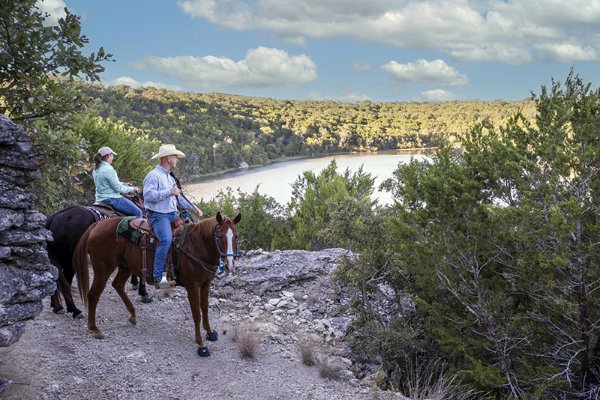
At the top of the dome at Enchanted Rock State Natural Area, you can see 25 miles in all directions, a jaw-dropping view of untouched Hill Country land that inspires a sense of awe in those who make it to the top of the 425-foot-high pink granite rock formation.
Enchanted Rock, which spans Gillespie and Llano counties in Central Texas, is often considered the jewel of the region, attracting more than 300,000 visitors a year.
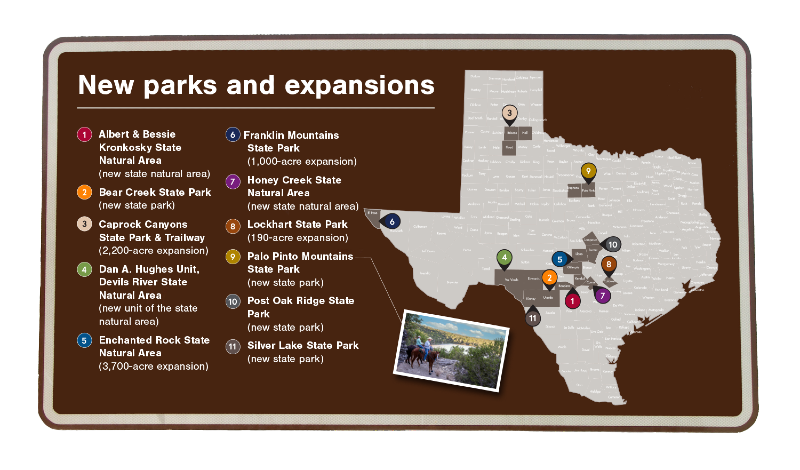
Soon, it will expand by 3,700 acres with 37 miles of new trails, more than doubling in size. It is one in a slate of Texas state park expansions and new parks and state natural areas the Texas Parks and Wildlife Department has planned for the coming years, with projects from the Panhandle to Central and South Texas.
“The acquisition of these future park properties comes at a pivotal moment as Texas’ population continues to grow,” said David Yoskowitz, executive director of the Texas Parks and Wildlife Department. “With all these new Texans, there’s an increasing demand for outdoor spaces we aim to meet.”
The park additions, while being majestic places for visitors, are also a boon to Texas counties and communities. People flock to parks for hiking, camping, fishing, climbing and birdwatching. They eat at local restaurants, stay in hotels and short-term rental homes, and even move to the area because of the enhanced quality of life.
According to a recently released study by Texas A&M University, Texas state parks generated $873 million in economic output in from December 2024 to November 2025 — a figure that has steadily increased over the years along with visitor counts. That output includes spending at hotels, restaurants, retail stores and other local businesses. Parks also supported an estimated 5,600 jobs.
It is these numbers that have helped drive additional investment in the state park system. During the past 50 years, annual state funding for parks has increased from $30 million to $165 million, due in part to a reduction in caps on sporting goods sales taxes that help fund the department. In 2023, Texas voters also approved a referendum providing $1 billion for new parks and park renovations.
“We changed the debate from state parks being nice places to take your family for a picnic to being economic engines in the counties they were based,” said John L. Crompton, a professor in Texas A&M’s hospitality, hotel management and tourism department and co-author of three economic impact studies for the Texas Parks and Wildlife Department. “The citizens in the counties get a great return on this spending.”
A park boom
In Palo Pinto County, Farm to Market Road 4 twists and turns, curving through rugged rolling hills from Santo to Lone Camp to Palo Pinto, a route that has become known to motorcyclists as the Possum Kingdom Lake Ride, a glimpse into this scenic part of Texas.
Southwest near Strawn, the Texas Parks and Wildlife Department in March opened one of the newest parks in its system, Palo Pinto Mountains State Park.
Jeff Hinkson, president of the Development Corporation of Strawn, says the geography is similar to the Hill Country but “maybe more dramatic.”
Visitors began booking day passes months in advance to be the first to visit the park. Wendy and Todd Pounds were among the nearly 30,000 who made the trek during its first two months, driving from Mansfield, Texas, in their RV to ride bikes on the trails.
“We have been anticipating the opening,” Wendy Pounds said. “We love getting out in nature, and where better than our state parks?”
Campsites are filling up quickly, and visitors are encouraged to make reservations for the weekends. “Right now, you’d be hard-pressed to get a day pass on a Friday,” Hinkson said. “It fills up in the morning, and they reassess at noon.”
Already, the county has seen eight new businesses open tied to the park, including a restaurant, ice cream shop and a local outfitter selling fishing and other outdoor gear. Soon, a new travel center will open south of Strawn, along with a hunting ranch to the north. As a result of the park, the county expects 110 full-time jobs to come online during the next 18 months, requiring more multifamily housing.
“We are looking at some abatements for specific types of businesses going in, to help with the infrastructure that will be needed,” Palo Pinto County Judge Shane Long said.
Hinkson said he expects during the next few years that Palo Pinto County will have a tourism economy, with now three state parks encircling the region, including Possum Kingdom State Park and Lake Mineral Wells State Park and Trailway.
“Palo Pinto County has been very blessed with the topography we have and the wildlife resources,” Long said. “We have capitalized on that.”
Marketing Texas parks
Gillespie County has no shortage of amenities drawing in visitors year-round. Tourists come to see wildflowers during the spring, eat peaches during the summer, to experience a vibrant holiday season or sip wine at the local vineyards.
“And all along, we’ve had Enchanted Rock,” said Tim Lehmberg, executive director of Gillespie County Economic Development Commission.
Justin and Jess Padia have been visiting the park since they first began dating. Now parents of two, they make regular visits to slow down and enjoy nature together. They have been there for family vacations, bachelorette parties, holidays, and they even got engaged and spent their honeymoon in nearby Fredericksburg.
“It’s an accessible and affordable way to enjoy quality time together,” Justin Padia said. “It’s also just a sense of allegiance and rite of passage to being a Texan. We feel it deeply and want to support protecting these areas for everyone to enjoy.”
Like many regular visitors, they are excited to see what comes of the expansion. In addition to the new trails, Texas Parks and Wildlife will add a new visitors interpretive center and open-air shuttle. In July, a new backcountry area opened at the natural area, inviting hikers to a more rugged section of the park.
“I think that’s just going to continue to bring more people to the Hill Country and then, with it, the economic benefit,” Lehmberg said.
Texas Parks and Wildlife is projecting the park will have 375,000 visitors a year, bringing in an additional $5.2 million annually to Gillespie and Llano counties.
Gillespie County is one of about 60 counties of the state’s 254 that collect hotel occupancy taxes, which are charged on short-term lodging stays and used to support visitors' bureaus, historical preservation, and arts and cultural programs, among other tourism uses. The ability to collect hotel occupancy taxes requires approval from the Texas Legislature. The county benefits from this funding, for stays outside the city limits.
“Wedding venues, lodging opportunities, many of them are highly successful in collecting lots of revenue,” Lehmberg said.
It’s just one tool in the toolkit for Texas counties.
Crompton stressed that it is equally important for counties to implement programming at the local state parks. In May, he ran a trail race in Bastrop State Park. Afterward, he went to a local restaurant to eat with friends. His wife, who is a birding enthusiast, travels to Galveston Island State Park every year for FeatherFest, along with 1,000 other birders.
“Whatever you put in brings people from further away because it’s worth their while, and they can stay longer and have more to do, particularly in rural areas,” Crompton said.
Whether visitors come from afar or enjoy these spaces as locals, the state’s investment in its parks will be transformative for Texas counties.
“It opens up opportunities in those communities that may have not had the critical mass to pull visitors to them before,” Lehmberg said. “It could be a game changer.”
“We look forward to conserving more of Texas’ unique landscape and creating more state parks and memories for the next generation,” Rodney Franklin, the Texas Parks and Wildlife Department director of state parks, said.