

County Magazine | April 30, 2026
Speaking to the future
A legendary horned toad, and why Texans keep sealing pieces of the present for generations to come
Even if you don’t recognize the title, you’ve probably seen the 1955 animated short “One Froggy Evening.” It’s one of the most beloved cartoons Warner Bros. ever produced, rivaling classics starring Bugs Bunny or Daffy Duck.
In it, a demolition worker finds a metal box sealed inside a building’s cornerstone. Inside is a frog that sings and dances with vaudevillian flair, but only when no one else is looking. The moment an audience appears, the frog freezes into an ordinary amphibian, ruining the worker’s dreams of fame and fortune and wrecking his sanity.
That wonderfully absurd cartoon traces its inspiration to a real-life time capsule sealed inside a Texas county courthouse.
The lizard in the cornerstone
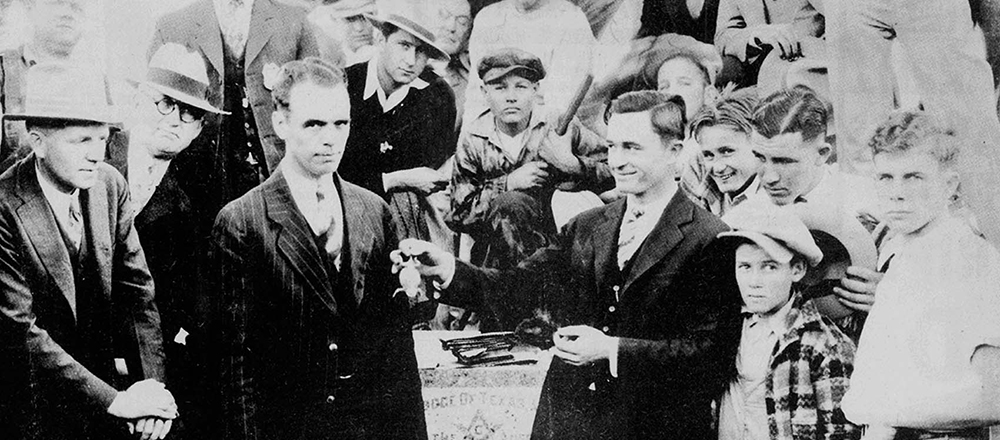
On Feb. 18, 1928, a crowd of about 1,500 gathered in Eastland around the remains of the old Eastland County Courthouse, which was being torn down to make way for a new one. Local dignitaries pried open a time capsule that had been sealed in the building’s cornerstone in 1897.
Inside, amid various bits of memorabilia, a Bible and a bottle of whiskey, they found a horned toad ... alive!
The lizard was promptly nicknamed “Old Rip” after Washington Irving’s Rip Van Winkle, on the assumption it had slept through the 31 years it had supposedly been entombed in the cornerstone. Old Rip had been placed there by Eastland County Clerk Ernest Wood, motivated by the folk belief that horned toads could survive harsh habitats by hibernating for decades.
Whether Old Rip truly survived that long — oh yes, there were skeptics who questioned whether he had really come from the capsule — hardly mattered. The story spread nationwide. Old Rip toured the country, appeared in newspapers from coast to coast, and even visited the White House to meet President Calvin Coolidge.
And then, as it must to all living things, death came for Old Rip — without question this time. Less than a year after his revival, Old Rip succumbed to pneumonia on Jan. 19, 1929. Today, his embalmed body lies in a red velvet-lined casket inside the Eastland County Courthouse.
Nearly a century later, the legend still pulses through Eastland’s economy and culture.
“When you say Eastland, people are like, ‘Oh, is that where Old Rip lives?’” Eastland County Clerk Cathy Jentho said. “So, it has kind of attached itself to the county.”
New county employees sometimes even take the Old Rip Oath, promising to uphold the legend. “We keep the story alive, still celebrate it,” Jentho said.
Sealing messages to the future
Old Rip’s story is singular, but the tradition that produced it is not.
In the late 19th and early 20th centuries, counties and cities across Texas buried time capsules beneath courthouse lawns, monuments and school campuses. Their contents were usually ordinary: newspapers, letters, photographs, coins.
The trend resurfaced in the 1970s, when many of those same communities marked their centennials.
In Jacksboro in Jack County, for example, residents buried a collection of time capsules in 1975 to celebrate the city’s 100th anniversary. Fifty years later, during the 2025 sesquicentennial celebration, officials prepared to open them.
The unveiling began with a small archival mystery. Jack County Clerk Vanessa James found an envelope labeled “time capsule” while replacing an old filing cabinet. Inside were two Polaroid photos of men in period dress and a list of buried items. They turned out to be from the 1975 ceremony.
The discovery led officials to the courthouse lawn, where the capsules were located. But time had taken its toll.
The containers had been made from thin-walled PVC pipe.
“We dug them up maybe a week or two before the sesquicentennial festival,” James said. “Every one of them was cracked.”
Most letters had disintegrated, but a few curiosities survived.
“There was a pill bottle in there,” James said. “It had water in it, and when I popped the top off, I pulled out a balloon that was a centennial balloon. It was perfectly preserved in water for 50 years in the ground.”
The salvageable items were put on display, and residents began assembling a new capsule to be opened on Jacksboro’s 200th birthday in 2075. Among the contributions were 200 newly minted pennies — included, James noted, because the penny faces a slow fade from circulation.
And the county auditor added another item: the current county budget.
“I think that’ll be interesting in 50 years,” James said.
Waiting patiently for the future
Clay County officials faced a similar situation in 2023 when they opened a capsule buried in 1973 for the county’s centennial. The concrete exterior had cracked, allowing water to corrode the metal interior. Officials salvaged what they could and digitized the surviving documents.
For the next capsule, to be opened in 2073 on Clay County’s 200th birthday, officials decided on a different approach. Instead of burying it outdoors, the new capsule will remain under the county clerk’s supervision inside the courthouse.
“I think it’s just better here in the building,” Clay County Judge Mike Campbell told KFDX-TV in December 2023 when the Commissioners Court passed a resolution sealing the new time capsule. “It gives us a warm, fuzzy feeling to know that people have been able to speak to the future.”
History, after all, can wait for the future to arrive just as patiently on a shelf as it can beneath the soil.
When time capsules are opened, they tend to reveal the fragments of everyday life, not miracles. That is where their appeal lies.
They are small acts of civic optimism. They embody the belief that something from the past might survive to speak, or sing, to the present. And someone in the future will care enough to listen.