

County Magazine | February 03, 2026
Above and beyond
How drones are reshaping county services across Texas
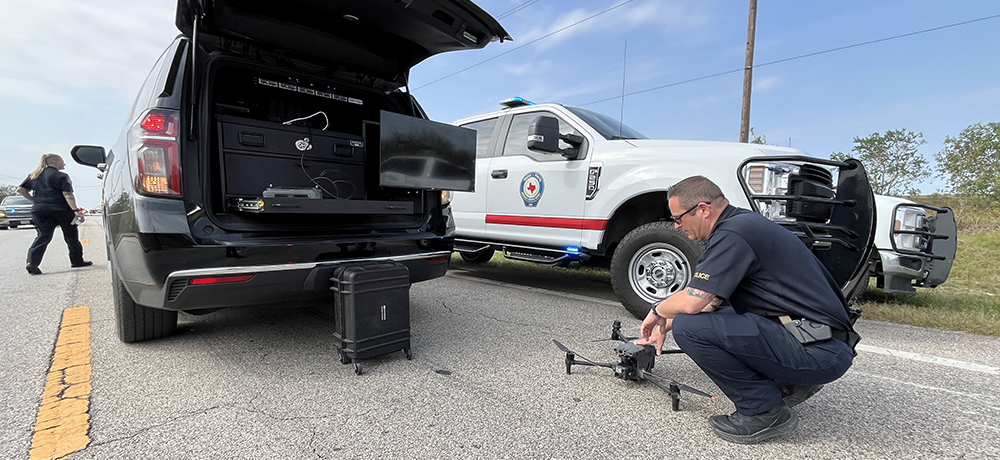
When Harris County’s hazardous materials teams first proposed using drones to assess dangerous situations, like chemical plant explosions or toxic gas leaks, the goal was simple: keep people out of harm’s way. Instead of sending crews directly in to take a gander, they could fly a $1,500 drone over raging fires or chemical spills to determine when it was safe for human responders to enter the scene.
And so far, the initiative has proved beneficial, protecting personnel while preserving manpower, allowing first responders to focus their time and resources on other emergencies.
“That drone can tell us exactly what hazard we’re walking into before anyone has to step foot in it,” said Rodney Reed, Harris County Fire Marshal’s Office chief. “It’s $1,500 versus the price of a funeral.”
That early effort launched one of the state’s most advanced county drone programs, and it’s now helping reshape emergency response across Texas.
Counties large and small are using drones for everything from flood recovery to arson investigations and agriculture assessment — and potentially even delivering medicine to remote areas.
Expanding county capabilities
Harris County, home to Houston, is the largest county in Texas by population, with more than 4.8 million residents. It also faces some of the state’s highest flood and hurricane risks, and county leaders have poured billions into infrastructure and resilience projects since Hurricane Harvey in 2017.
The Harris County Fire Marshal’s Office first deployed drones for hazmat reconnaissance about a decade ago, using them to safely assess incidents such as chemical spills, tanker truck crashes and even refinery fires. Since then, the county has expanded its use to fire and arson investigations, using overhead photogrammetry to locate points of origin and assess structural safety before entering damaged buildings.
“We’ve seen drones really materialize themselves as a value add in government,” Reed said. “They increase efficiency and safety.”
Beyond public safety, other county departments have found new applications. Engineering teams use drones to assess property damage after disasters, while radio technicians rely on them to inspect communication towers, saving both time and money.
New frontiers in rural corners
In Presidio County, one of the most remote counties in the Lone Star State, drones could soon do something entirely different — deliver medicine.
Doctors in Lubbock can already examine patients remotely through telehealth appointments, but getting prescriptions into patients’ hands is often the bigger challenge, especially for rural areas. The county hospital, in partnership with Texas Tech University Health Sciences Center, successfully conducted test flights in 2023 to deliver prescriptions and medical equipment, though the program is not yet fully implemented. After nearly two decades in the region, the clinic’s director said drones could be a game changer.
Drones could also prove invaluable in search-and-rescue efforts across the rugged terrain of Far West Texas, helping locate people who are missing or lost, such as hikers in Big Bend National Park or Davis Mountains State Park, where quick access can mean the difference between life and death.
Several Texas counties are also embracing drones as a new tool in modern agriculture. The Texas A&M AgriLife Research and Extension Center in Amarillo began deploying drones in 2019, using hands-off aerial monitoring to identify sick livestock and address challenges in range management and crop monitoring.
Counties across the state have begun adopting these technologies in different ways since the program was first implemented. Earlier this summer, AgriLife in Bosque and Johnson counties hosted a demonstration, giving local farmers the chance to see drones in action for pasture and range plant identification and herbicide application.
In Schleicher County, AgriLife officials partnered with a private drone company to showcase to youths in the 4-H program how unmanned aircraft can assist with agricultural operations.
As drone technology becomes more accessible and sophisticated, more Texas counties are expected to integrate it to support sustainable practices in rural communities, both in agriculture and health care.
Challenges using drone technology
Reed, who helped in recovery efforts after last year’s devastating July 4 floods, still wears a bracelet given to him by the grandmother of Cile Steward, the only remaining missing child from Camp Mystic.
He said drones played a key role in rescue-and-recovery efforts after the disaster, when multiple aircraft assisted in search-and-rescue operations. The technology will continue to be used in such emergencies.
“We utilize a lot of our time in the recovery piece, going and searching for these technologies,” Reed said. “And what I’ll tell you is, there’s a lot of really good things that are happening out of that incident, in the wake of such tragedy and loss of life.”
The influx of drones can introduce challenges, especially when drones are flown by the public. In Kerr County during recovery efforts, a collision occurred between a private drone and a rescue helicopter. The incident, officials say, became a lesson in coordination and airspace management.
“We call that ‘plastic on metal,’ and it’s the worst thing that can happen,” the Harris County official said. “It’s a problem in this space because drones are so affordable and accessible to the public.”
Despite the risks, the Kerrville response also showcased technology’s potential. Teams deployed thermal-imaging drones at twilight to detect small temperature differences — as little as 5 degrees — that could help locate victims. Other emerging tools, such as ground-penetrating radar, are now being studied for future use.
“The silver lining,” he said, “is that the state is coming together — operationally and technologically — so that the next time something like this happens, the response will be faster and safer.”
Still, widespread drone use brings new challenges. Counties must navigate changing regulations, privacy concerns and the cost of new technology.
The 89th Texas Legislature recently moved to restrict the use of Chinese-made drones, which are among the most common in public safety because of their affordability and advanced features, Reed said. That has left counties searching for new suppliers.
Local governments must also comply with state law by publicly posting drone flight logs every two years and ensuring operations meet privacy and open-records requirements. Harris County’s drone policy has been vetted up to the national level — through the Governor’s Office, the Federal Emergency Management Agency and even civil rights groups — to ensure it protects privacy and constitutional rights.
“It’s a fine balance,” Reed said. “We want to push the boundaries of this technology, but we also have to make sure we’re not wasting taxpayer dollars or violating public trust.”
The future of county response
From Houston’s urban skyline to Presidio’s desert frontier, Texas counties are proving that drones aren’t replacing people; they’re protecting them.
What began as an effort to keep first responders out of danger is now expanding into medicine, mapping and more. The technology may still face hurdles, but counties agree on one point: Drones are becoming essential tools for public service.